Engagement Farming Strategies Used by Top Accounts
Ever wonder why some posts with average content rack up thousands of comments while genuinely great posts vanish into the feed abyss?
The answer often isn’t luck, it’s engagement farming.
Engagement farming is one of the most misunderstood tactics in social media today. Some see it as manipulation. Others quietly use it as a growth lever. The truth sits somewhere in between. When used strategically and ethically, engagement farming explains why top accounts dominate visibility across platforms like Instagram, TikTok, X, and YouTube.
In this article, you’ll learn:
- What engagement farming actually is
- Why it works across algorithms
- How top accounts use it without getting penalized
- How to tell smart engagement strategies from spammy ones
Everything here is grounded in platform documentation, algorithm behavior analysis, and social analytics best practices, not hype or shortcuts.
What Is Engagement Farming? (And Why It Works)
At its core, engagement farming refers to tactics designed to intentionally increase interactions:
- Likes
- Comments
- Shares
- Saves
- Replies
- Watch time
to signal relevance to social media algorithms.
Unlike simple “posting consistently,” engagement farming is about engineering interaction.
Social platforms don’t rank content based on quality alone. They rank content based on response. Algorithms interpret engagement as proof that content is valuable, interesting, or worth distributing to more users.
Why engagement signals matter to algorithms
- Higher engagement = broader distribution across feeds and discovery pages
- Early interaction increases velocity, which platforms prioritize
- Comments, shares, and saves often weigh more than likes
- Engagement quality helps algorithms predict user satisfaction
In other words, engagement farming works because it aligns with how algorithms are designed to surface content that people actively respond to.
Engagement farming isn’t always cheating but it can sometimes count as cheating.
That distinction matters.
Why Top Accounts Use Engagement Farming (Strategically)
Top creators and brand accounts don’t rely on content quality alone. They understand a hard truth of social media: great content without interaction is invisible.
Even high-production posts can underperform if they don’t spark immediate response. Engagement farming helps solve three key problems:
- Breaking through feed competition
- Triggering algorithmic distribution
- Extending content lifespan
What top accounts gain from engagement-focused strategies
- Faster reach in the first 30–60 minutes after posting
- Increased chances of landing on Explore, For You, or Suggested feeds
- Stronger audience signals for future posts
Large accounts also face declining organic reach as follower counts grow. Engagement farming helps counteract that by proving continued relevance.
Importantly, top accounts don’t chase engagement blindly, they optimize how interaction happens.
Smart vs Spammy Engagement Farming Tactics
This is where engagement farming either becomes a sustainable strategy or a long-term liability.
Smart (Algorithm-Safe) Engagement Farming Tactics
These tactics align with user intent and platform guidelines:
- Asking open-ended questions that invite real opinions
- Using platform-native features (polls, sliders, stitches, replies)
- Creating content that requires interpretation or choice
- Encouraging discussion rather than one-word responses
- Designing posts that reward thoughtful comments
Examples include:
- “Which option would you choose and why?”
- “This result surprised me. What do you think?”
- “Watch until the end and tell me if you agree.”
Spammy (Risky) Engagement Farming Tactics
These tactics focus on volume, not quality, and are often flagged:
- Like-for-like or follow-for-follow schemes
- Comment baiting (“Comment YES”, “Drop an emoji”)
- Engagement pods or coordinated interaction groups
- Repetitive CTAs on every post
- Artificial engagement spikes from low-quality accounts
Click Farms: The Dark Side of Artificial Engagement
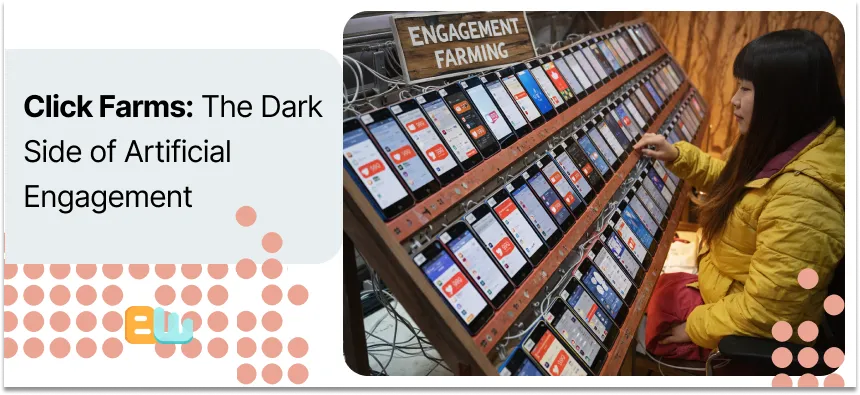
While some spammy engagement tactics are minor annoyances, click farms represent a more extreme and risky form of engagement manipulation. Click farms are operations where large groups of low-quality or fake accounts are used to generate likes, comments, shares, or follows in bulk. The goal is to make content appear more popular than it actually is.
How click farms work:
- Teams of people (or automated bots) create thousands of accounts.
- These accounts are then directed to like, comment, or follow posts repeatedly.
- Activity is often repetitive, low-quality, and easily identifiable by algorithms.
Why they’re dangerous:
- Algorithms are designed to detect unnatural patterns. Sudden spikes in engagement from unrelated accounts are a major red flag.
- Accounts using click farms risk penalties, including reduced reach, shadowbanning, or even permanent account suspension.
- Engagement from click farms rarely translates to real audience growth or meaningful interaction, it’s purely artificial.
Bottom line: click farms may create the illusion of popularity, but they don’t build genuine community or sustainable growth. Top accounts avoid them because authentic engagement always outperforms artificial signals in the long run.
Smart vs Spammy Engagement Farming (Comparison Table)
| Tactic Type | Short-Term Gain | Long-Term Risk | Algorithm Impact |
| Open-ended questions | Moderate | Low | Positive distribution |
| Polls & native tools | High | Low | Strong platform boost |
| Comment baiting | High | High | Reach suppression |
| Engagement pods | Temporary | Very high | Pattern detection |
| Meaningful discussion prompts | Steady | Low | Sustained growth |
Smart engagement farming aligns with user intent; spammy engagement exploits it.
Platform-by-Platform Engagement Farming Strategies
Engagement farming looks different depending on the platform because algorithms prioritize different signals.
Instagram favors comments, saves, and time spent.
Effective tactics:
- Carousel posts that encourage swiping
- Questions embedded in captions
- Story polls and sliders
- “Save this for later” prompts tied to value
Instagram penalizes repetitive or low-effort engagement bait more aggressively than before, making quality interaction critical.
TikTok
TikTok prioritizes watch time, replays, and comment velocity.
Effective tactics:
- Hook-driven openings that encourage full watch-through
- Comment-based follow-up videos
- Asking viewers to weigh in on controversial or surprising takes
- Stitch-friendly content
TikTok engagement farming works best when comments drive more content.
X (Twitter)
X emphasizes reply velocity and conversation depth.
Effective tactics:
- Opinionated hooks
- Threads ending with questions
- Quote-tweet prompts
- Timely reactions to trending topics
Low-effort engagement bait performs poorly compared to thoughtful discourse. You can take a deeper dive on Twitter(X) engagement metrics on our Master Twitter Analytics as X Redefines Engagement
article.
YouTube
YouTube prioritizes watch duration and session time.
Effective tactics:
- End-of-video questions
- Pinned comments that invite discussion
- Community polls
- Encouraging viewers to share personal experiences
Engagement Signals by Platform (Comparison Table)
This table helps put everything into perspective:
| Platform | Top Engagement Signal | What Top Accounts Focus On |
| Comments & Saves | Swipe-worthy carousels | |
| TikTok | Watch Time | Strong hooks + replays |
| X | Replies | Opinion-driven posts |
| YouTube | Watch Duration | Retention-focused storytelling |
How Algorithms Detect Engagement Farming (And Penalize It)
Platforms don’t just count engagement, they analyze patterns.
Common detection signals
- Sudden engagement spikes from unrelated accounts
- Repetitive comment language across posts
- Low dwell time despite high likes
- Engagement loops between the same users
- High interaction with no follow-through behavior
When flagged, content may experience:
- Reduced reach
- Removal from discovery feeds
- Temporary account throttling
This is why quality engagement consistently outperforms artificial boosts.
Data, Tools, and Signals Top Accounts Monitor
Top accounts don’t guess, they measure relentlessly. Engagement farming at a high level is driven by data, not instinct. Instead of focusing on vanity metrics like total likes or follower count, successful creators and brands pay close attention to how, when, and why people interact with their content. These signals help them understand what algorithms are actually rewarding.
Key engagement metrics top accounts track include:
- Engagement velocity – how many interactions occur in the first 30–60 minutes, a critical window for distribution
- Comment depth – multi-word, conversational replies indicate higher content value than simple emojis
- Save-to-like ratio – a strong indicator of long-term usefulness, especially on Instagram
- Share rate – signals content relevance beyond the original audience
- Retention vs. reaction – comparing watch time or dwell time against surface-level likes
To monitor these signals, top accounts rely on a mix of native platform analytics and third-party tools. Built-in insights reveal reach, retention, and interaction timing, while social listening tools help analyze sentiment and recurring discussion themes. Many also use A/B testing for captions, hooks, and posting formats to identify which engagement prompts perform best. Over time, they monitor comment quality trends, not just volume.
The focus isn’t just more engagement, it’s better, algorithm-friendly signals that compound growth.
Conclusion: Engagement Farming Isn’t Going Away; It’s Evolving
Engagement farming isn’t a loophole or a hack, it’s a reflection of how social platforms work. Algorithms reward interaction because interaction signals value.
The accounts that thrive long-term don’t chase engagement at any cost. They design content that naturally invites response, conversation, and attention, without crossing into manipulation.
If there’s one takeaway, it’s this: engagement farming works best when it feels like engagement, not farming.
Focus on interaction that adds value, and the algorithms will follow.
Frequently Asked Questions (FAQ)
What is the meaning of engagement farming?
Engagement farming is the practice of intentionally prompting interactions (likes, comments, shares, watch time) to increase a post’s visibility within platform algorithms.
Is engagement farming against platform rules?
Not inherently. Engagement farming becomes a violation when it involves manipulation, fake accounts, or coordinated artificial activity.
Does engagement farming actually work?
Yes — because algorithms use engagement as a ranking signal. However, quality engagement works better than volume alone.
What’s the difference between engagement farming and organic growth?
Organic growth focuses on content quality alone. Engagement farming strategically enhances interaction to support distribution.
How do algorithms detect fake engagement?
Algorithms analyze patterns like repetitive comments, sudden spikes, low retention, and coordinated behavior.
Can engagement farming hurt reach long term?
Spammy engagement tactics can reduce reach over time. Sustainable strategies improve long-term visibility.
