What Is the Difference Between Memes and GIFs? Don’t Confuse Them Anymore
If you think memes and GIFs are the same, then you’re gonna need to read this article till the end.
We’ve all definitely confused these two together at least once. Some even don’t know that these two words are different and not synonyms.
The internet hasn’t exactly helped clear things up either. Memes evolve. GIFs loop forever. And sometimes they overlap so hard that even seasoned internet users hesitate before naming what they’re looking at.
This article will help to end that confusion once and for all.
By the end of this article, you’ll:
- Know exactly what a meme is and exactly what a GIF is
- Understand why people confuse these two internet phenomenon
- Learn how a GIF becomes a meme
- Be able to confidently use both in their right context
Let’s get into it before you get into your next twitter (X) fight.
What Is a Meme? (It’s More Than Just a Joke)
At its core, a meme is an idea that spreads.
The word “meme” didn’t even start on the internet. It was coined in 1976 by evolutionary biologist Richard Dawkins, who used it to describe how cultural ideas replicate, mutate, and spread, much like genes do. The internet simply gave memes rocket fuel.
In modern internet culture, a meme is:
- A shared idea, joke, or behavior
- Repeated and remixed by many people
- Recognizable even when slightly changed
Memes can take many forms:
- Static images with text
- Videos
- Screenshots
- Catchphrases
- GIFs (yes, sometimes!)
What matters isn’t the format, it’s the concept and context.
Key characteristics of memes
- Relatability: “This is so me” energy
- Repetition: You see it everywhere
- Adaptability: People add their own spin
- Cultural meaning: It comments on something shared
Any image has the potential to be a meme if people understand what it represents, without needing an explanation. That shared understanding is the secret sauce that many brands use to connect with their audience in the form of meme marketing.
What Is a GIF? (A Format, Not a Concept)
A GIF is not an idea. It’s a file format.
GIF stands for Graphics Interchange Format, and fun fact? it’s been around since 1987 so no it’s not something new that developed with social media, it had been around long before social media, memes, or group chats filled with chaos were a thing.
Technically speaking, a GIF is a short, silent animation made from a sequence of images that keeps looping.
What defines a GIF:
- Short animation
- No sound
- Loops automatically
- Works almost everywhere online
GIFs shine because they’re emotionally expressive without being overwhelming. They sit perfectly between a static image and a full video.
That’s why they’re everywhere:
- Messaging apps
- Social media comments
- Reaction replies
- Workplace chats
A raised eyebrow. A slow clap. A dramatic eye roll. GIFs say a lot without saying a word.
Meme vs GIF: The Difference That Actually Matters
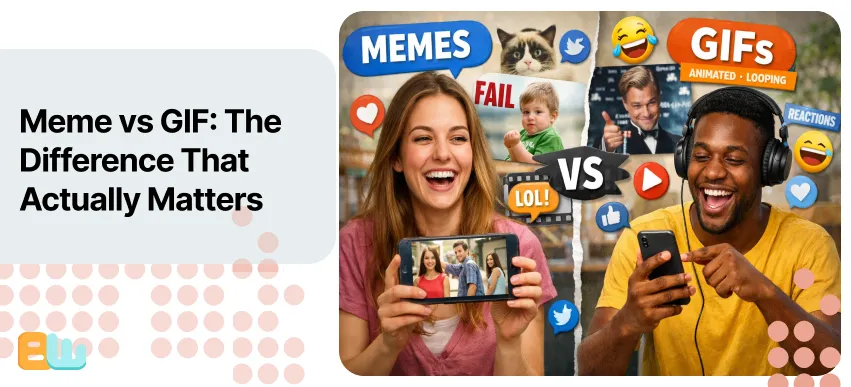
Here’s the simplest way to think about it:
Memes are messages. GIFs are motion.
A meme is about meaning.
A GIF is about movement.
This is where most confusion comes from, because a GIF can be used as a meme, but that doesn’t make all GIFs memes.
Where the confusion happens
- A popular reaction GIF gets reused constantly
- People add captions to a GIF
- The GIF becomes associated with a specific joke or feeling
At that point, the GIF is no longer just a file, it’s carrying a shared cultural idea. That’s when it crosses into meme territory.
Important distinction
- All memes are not GIFs
- All GIFs are not memes
- Some memes happen to be GIFs
That overlap is real, but they are not interchangeable terms.
When Does a GIF Become a Meme?
A meme is created when a GIF gets a context and people generally recognize it.
If people on the internet see your GIF and immediately understand the joke, emotion or reference you are trying to convey then congratulations a new meme has been born.
A helpful way to understand this crossover is to look at how a GIF evolves.
Most GIFs start out as simple clips:
- a scene from a show
- a reaction moment
- a visual joke
At this stage, they’re just animated responses. But sometimes, a specific GIF gets reused in the same emotional or situational context again and again.
Here’s what usually happens:
- A GIF is shared repeatedly
- People start associating it with a specific feeling or situation
- The meaning becomes instantly recognizable
- The GIF no longer needs explanation
Once that happens, the GIF stops being just a reaction and starts functioning like a meme. It carries a shared understanding. People aren’t just seeing a fun little video clipping, they are getting the context and the message from just a 1-5 second clip.
Timing also play a role, a GIF is more likely to become a meme when it appears during a huge cultural moment which a large number of people collectively experience.
Repetition makes it stick.
Recognition makes it last.
Without these a GIF stays that, just a GIF. It is expressive but not symbolic.
This is why some GIFs feel iconic while others fade quickly. Memes survive because people reuse the idea, not just the image.
Why This Difference Actually Matters
At first glance, this might feel like internet nitpicking. But in online spaces where conversation moves fast, understanding the difference between memes and GIFs will help you communicate clearly and more intentionally in an online space.
Think about everyday situations:
- In a group chat, a GIF works best when you want to react without derailing the conversation.
- A meme, on the other hand, usually becomes the conversation, it introduces commentary, humor, or shared frustration.
This distinction matters even more in public spaces like social media comments. A reaction GIF signals emotion without commitment. A meme signals opinion, alignment, or critique. Choosing the wrong one can make your response feel confusing, out of place, or unintentionally intense.
There’s also a subtle social skill at play here: digital literacy. Just like knowing when to use emojis versus words, understanding memes versus GIFs shows awareness of how online culture works. It’s not about being “chronically online”, it’s about reading the room in a digital space.
In short, memes and GIFs aren’t interchangeable because they serve different communication goals. One explains. The other reacts. And when you understand that, your online presence becomes sharper and more intentional.
Remember this line:
Memes carry meaning. GIFs carry motion.
When to Use a Meme vs When to Use a GIF
If you’ve ever hesitated before posting, this section is for you.
Use a meme when you want to:
- Make a joke about a shared experience
- Comment on a trend or situation
- Say something without directly saying it
- Be relatable or ironic
Memes work best when you’re adding commentary.
Use a GIF when you want to:
- React quickly
- Show emotion
- Respond in a conversation
- Add personality without hijacking the moment
GIFs work best as responses, emotional punctuation for online conversations.
It also helps to know when not to use each format.
When a meme might not be the best choice:
- In fast-moving conversations where context isn’t shared
- In private chats where the joke needs too much explanation
- When timing matters more than commentary
Memes require interpretation. If the audience doesn’t immediately “get it,” the moment is lost.
When a GIF might fall flat:
- When you actually need to express an opinion
- When reacting feels dismissive or unclear
- When the moment calls for humor with substance
GIFs are excellent emotional shorthand, but they can feel vague if the situation requires clarity.
A good rule of thumb:
- Use a GIF when you’re responding
- Use a meme when you’re saying something
Once you start thinking this way, choosing between the two becomes automatic and your online communication feels smoother, sharper, and more confident.
Platforms where both thrive
- TikTok
- X (Twitter)
- Messaging apps (iMessage, WhatsApp, Slack)
Each platform blends memes and GIFs differently, but the core rules stay the same.
Why People Keep Mixing Them Up (And Probably Always Will)
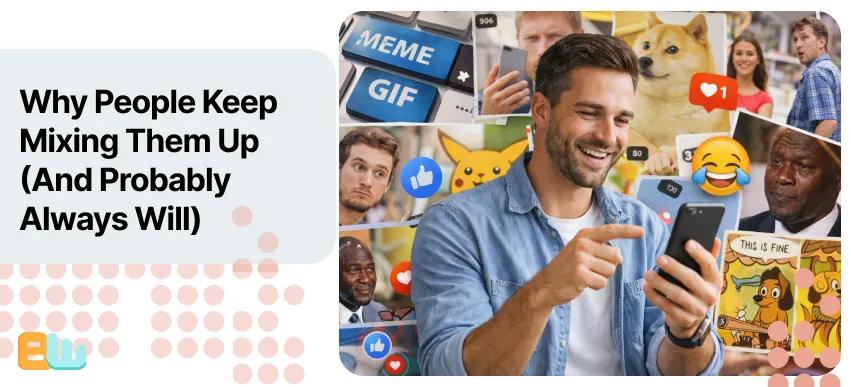
Language evolves. Internet language evolves even faster.
Over time, “meme” has become shorthand for “funny internet thing,” while “GIF” often gets used to mean “that moving meme I sent you.” This is normal. It’s how culture works.
But technically and culturally, the difference still exists and understanding it gives you clarity instead of confusion.
You don’t have to correct people. You just have to know.
Frequently Asked Questions
Is a GIF a meme?
Sometimes. A GIF becomes a meme when it carries a shared cultural meaning beyond just motion.
Can memes be GIFs?
Yes. Animated memes exist and are extremely common.
Do memes always have text?
No. Many rely purely on shared understanding, images, or motion.
Are GIFs still relevant?
Absolutely. They remain one of the most widely used tools for online reactions and emotional expression.
Why do people call everything a meme?
Because “meme” has become a cultural catch-all term, even when it’s not technically accurate.
What’s the easiest way to tell the difference?
Ask yourself: Is this expressing a reaction, or communicating an idea?
Reaction = GIF.
Idea = Meme.
Final Takeaway: Don’t Stress It
You don’t need to police internet language. You don’t need to correct your friends. But now, you do understand the difference.
Memes are about shared meaning.
GIFs are about shared emotion.
Sometimes they overlap. Sometimes they don’t. And now, you’ll never confuse them again.
Internet culture unlocked.
