Why Holographic Ad Campaigns Are the Future of Brand Storytelling
According to a 2023 Nielsen report, traditional advertising’s effectiveness has decreased by 30% in the last ten years. Brands are looking for creative ways to stand out as customers grow pickier about the information they consume. Presenting holographic advertising, a technique that uses no special glasses or headsets to bring brand tales to life in three dimensions.
The advertising industry has many difficulties nowadays. More than 86% of customers suffer from digital ad blindness, and they have mastered the art of ignoring sponsored content, banner ads, and even video ads. The average person now sees between 4,000 and 10,000 advertisements per day on social media networks, which are becoming more and more cluttered.
The next step in brand storytelling is represented by holographic advertising campaigns. Brands can avoid digital weariness and produce unforgettable experiences that pause people in their tracks by producing immersive, floating 3D graphics that appear in real-world locations.
This article examines the operation of holographic technology, as well as its psychological effects, commercial advantages, practical applications, and implementation techniques. You’ll learn why progressive companies are already spending money on this ground-breaking strategy to engage consumers in previously unattainable ways.
1. The Evolution of Advertising Technology
1.1 From Print to Digital: The Journey So Far
As technology has advanced, so too has advertising. Prior to radio commercials catching on in the 1920s, print ads were the norm for centuries. The 1950s saw a visual revolution brought about by television advertising, and the 1990s saw yet another upheaval brought about by the internet.
Unprecedented analytics and targeting capabilities were brought about by the digital revolution, but it also brought about issues. Ads proliferated alongside screens in our daily lives. A paradox resulted from this: the effectiveness per impression decreased as the number of ad exposures increased.
Today’s digital advertising faces significant limitations. Two-dimensional screens confine creativity, and users have developed “banner blindness” – a documented phenomenon where people automatically ignore anything that looks like an advertisement.
1.2 Enter Holographic Technology
Without the need for specific gear, holographic displays produce three-dimensional pictures that seem to float in real space. Contemporary holographic technology produces images with true depth and dimension, in contrast to conventional projections that appear on flat surfaces.
It’s crucial to understand how augmented reality (AR) and virtual reality (VR) differ from holographic displays. While holographic displays are visible to everyone nearby without the need for specialized equipment, AR and VR need users to wear gadgets.
2. The Science Behind Holographic Advertising
2.1 How Modern Holographic Technology Works
Commercial holographic displays of today generate their floating pictures using a variety of technologies. By simulating the way light naturally bounces off things, light field technology produces lifelike 3D images that adapt to the viewer’s movements.
Using quickly moving parts or specific materials, volumetric displays produce real 3D points of light in space. These create truly three-dimensional images rather than the illusion of depth.
Projection mapping has advanced to use multiple synchronized projectors with specialized films and surfaces. This creates images that appear to float in mid-air when viewed from the correct angles.
2.2 Types of Holographic Advertising Solutions
Brands can deploy holographic advertising through several formats:
Mobile holographic experiences: Transportable units that produce pop-up 3D displays at events Wearable holographic technology: Compact personal devices with holographic capabilities Free-standing holographic displays: Self-contained units that project 3D images in retail environments Holographic store windows: Convert ordinary storefront glass into enchanted displays visible from the street
Holographic billboards: enormous outdoor displays that are simultaneously visible to a large number of individuals. Interactive holographic kiosks are touch-sensitive devices that alter their screens in response to user input.
2.3 Current State of Holographic Display Technology
Image quality has significantly increased with recent developments. With some high-end displays reaching up to 4K resolution per eye view, the most recent commercial systems offer resolutions that are close to photorealism.
Size capacities are been increased. These days, systems range from 12-inch figures made by tabletop machines to enormous installations that can project images 20 feet high for events and public areas.
The majority of technologies still have viewing angle restrictions; visibility is best within 120 to 140 degrees. Newer systems, some of which can see almost 180 degrees, are extending this range, though.
3. The Psychological Impact of 3D Storytelling
3.1 Immersion and Memory Retention
Compared to 2D visuals, our brains interpret 3D objects differently. Compared to flat visual processing, spatial processing stimulates more brain regions, strengthening neural connections and improving memory formation, according to neurological study from the University of California.
According to a Stanford University study, material displayed in 3D had a 73% higher recall rate than the same information displayed in 2D. When examined weeks later, this striking difference remained.
The element of novelty is also quite important. As a survival mechanism, the human brain is hardwired to focus on novel and unexpected stimuli. Because holographic displays defy our preconceived notions about how pictures should look, they generate this attentional reaction.
3.2 Breaking the Fourth Wall in Advertising
Holographic displays blur the line between the environment and advertising. A new car appearing in front of prospective buyers or a life-sized tiger walking through a mall elicits a completely different response than when same visuals are displayed on a screen.
This creates what marketing psychologists call “brand moments” rather than mere brand messages. A brand moment is an experience so unusual that it creates an emotional bookmark in memory, associated directly with the brand.
The shareable nature of these experiences amplifies their impact. Consumers are 32% more likely to post unexpected physical events on social media than digital advertisements, according to Gartner research, which generates organic reach through social proof.
4. Business Benefits of Holographic Advertising
4.1 ROI and Conversion Benefits
Holographic displays deliver measurable results. Retail implementations show average footfall increases of 17-24% according to a 2022 Retail Customer Experience study. More importantly, these aren’t just curious onlookers – conversion rates for products featured in holographic displays average 43% higher than traditional displays.
The initial cost of holographic technology is more than that of traditional signage, but when compared to the results, the cost of acquiring new customers is frequently lower. According to a 2023 Deloitte report, holographic displays are cost-effective for many applications even though they are three to five times more expensive than high-end digital signs. They also provide two to seven times the engagement.
4.2 Brand Differentiation and Market Positioning
Brands using holographic technology position themselves as innovative leaders. This perception extends beyond the specific product being advertised to enhance overall brand equity.
Even when the actual items stay the same, brands that use developing display technologies score 18% higher on “premium quality” associations and 27% higher on “innovation perception” criteria, according to the Association of National Advertisers.
Long after watching the holographic commercial, these perceived advantages continue to exist, producing a halo effect that affects subsequent purchases.
5. Examples and Case Studies: Pioneering Holographic Campaigns
5.1 Retail Success Stories
Holographic sneaker displays that highlighted construction aspects by showing shoes deconstructing in midair caused a stir for Nike. Store managers reported 34% increased time spent in the footwear section and a 28% sales lift for featured models.
Sephora implemented holographic makeup testing stations that projected different looks onto customers’ faces in real-time. This resulted in a 47% increase in product trials and a 23% lift in sales of featured cosmetics lines.
5.2 Entertainment and Event Marketing
By putting hologram dinosaurs from its Jurassic World franchise in public areas, Universal Pictures caused a viral phenomenon. Over 50 million organic social media impressions were produced by the campaign, which equates to $3.7 million in earned media advertising value.
Holographic elements have been used as upgrades and advertisements at music events such as Coachella. A holographic display promoting headliners generated 4.8 times more social shares than traditional promotional materials.
Museums have found educational applications that double as marketing. The holographic dinosaur show at the American Museum of Natural History garnered a lot of media attention and boosted youth attendance by 42% during its duration.
5.3 B2B Applications
Complex B2B products particularly benefit from holographic display. Medical device manufacturer Medtronic reported 68% improved understanding of their surgical systems when presented holographically compared to video presentations.
Trade show implementations create significant competitive advantages. When compared to standard displays, businesses that use holographic displays at industry conventions report 2.7 times the qualified lead generation and 3.2 times the booth traffic.
According to a 2023 Forrester survey of B2B sales environments, client experience centers with holographic capabilities exhibit 23% faster sales cycles and 41% higher meeting acceptance rates.
6. Implementation Strategies for Brands
6.1 Budget Considerations and Scaling Options
Small tabletop displays that are appropriate for retail counters or product launches start at about $3,000 to $5,000 for entry-level holographic solutions. Depending on their size and level of interaction, mid-range choices such as holographic kiosks can cost anywhere between $10,000 to $30,000.
Although they can be spread over several sites or campaigns, enterprise-grade deployments for flagship stores or significant events usually cost between $50,000 and $250,000.
Nowadays, a lot of suppliers provide leasing choices for short-term installations; they usually cost 15–25% of the purchase price each month. This enables companies to evaluate efficacy prior to making permanent installations.
6.2 Integration with Existing Marketing Channels
Holographic campaigns that are successful link to other marketing initiatives. By directing viewers to websites or social media platforms, QR codes integrated into the holographic display can serve as a link between digital and real-world events.
Data collecting is still very important. In order to feed this data into more comprehensive marketing analytics platforms, modern systems are able to anonymously track viewer characteristics such as dwell duration, demographic estimations, and interaction patterns.
Holographic aspects reinforce traditional advertising themes rather than existing separately in the most successful implementations, which produce cohesive storylines across channels.
6.3 Phased Implementation Approach
Pilot initiatives in busy areas are a good place for most brands to start. This enables testing and improvement prior to broader use.
Targeting by geography maximizes impact. Due to increased foot traffic and more receptive consumers to new ideas, holographic implementations usually receive the strongest reaction in urban areas and flagship stores.
By taking advantage of times when customer interest is inherently higher, seasonal deployments around important shopping occasions or product launches sometimes yield the highest return on investment for retail applications.
7. Content Creation for Holographic Media
7.1 Design Considerations Unique to Holographic Displays
The production of content for holographic displays is very different from that of regular media. Modeling in three dimensions necessitates taking into account an object’s entire aspect, not just what is visible from the front.
Because holographic displays handle brightness differently than screens, particular consideration must be given to color and lighting. High contrast, vibrant colors work best in a variety of lighting conditions.
Careful planning is necessary for movement. Rapid moves that can disrupt the illusion of three-dimensionality are usually less effective than slow, flowing movements in producing believable holographic pictures.
7.2 Production Resources and Requirements
Creating content usually calls for specific knowledge of 3D modeling, animation, and holographic optimization. Instead of trying to produce their products in-house, many brands collaborate with specialized agencies.
Professional 3D modeling programs like Maya or Blender, as well as specialist rendering software for holographic output formats, are among the software needs.
Timeline planning should allow for iteration. Unlike traditional video where what you see in production is what you get, holographic content often requires adjustment when seen in the actual display environment.
8. Limitations and Challenges
8.1 Environmental Constraints
Holographic display visibility is greatly affected by lighting conditions. Although modern technologies are enhancing outside capabilities, most devices work best in controlled inside situations.
Technology-specific space needs differ, but generally speaking, unhindered viewing areas are needed. Certain systems require particular installation depths, which might not be suitable for every shop or event setting.
Temporary installations may face difficulties due to power and communication requirements. For content updates and performance monitoring, the majority of professional-grade systems need dedicated power circuits and, more and more, network connectivity.
8.2 Regulatory and Public Safety Considerations
Displays that can divert drivers are subject to laws in some jurisdictions. It could be necessary to get special permits or make placement adjustments for outdoor installations close to roads.
Accessibility issues need to be taken into account. Accessibility guidelines must be followed by any interactive features, and holographic displays should be placed at heights that wheelchair users can see.
New technology might occasionally have repercussions for insurance. For holographic exhibits, especially those with interactive elements, some locations would need extra liability coverage.
8.3 Disadvantages of Holographic Technology
For smaller brands, cost is still a major obstacle. Many small firms cannot afford the high cost of complex hologram marketing.
Restrictions on viewing angles, problems with brightness in direct sunlight, and resolution limits in comparison to the greatest 2D displays are some of the current technical constraints.
More upkeep is needed than with conventional digital signs. For most systems to continue operating at their best, routine calibration and specific cleaning techniques are required.
9. The Future Landscape of Holographic Advertising
9.1 Emerging Technologies Enhancing Holographic Displays
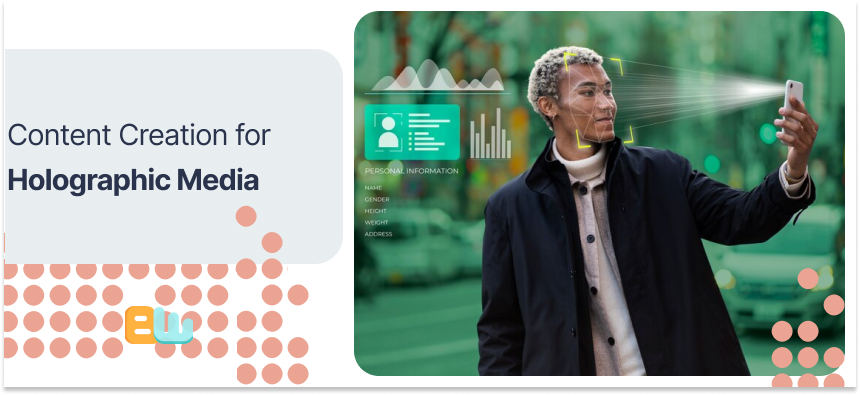
Customized holographic experiences that adjust to each viewer are being produced through the integration of artificial intelligence. Content based on demographic profiles or even emotional states might be triggered by facial recognition.
Developments in haptic feedback are giving holographic displays tactile components. These days, some systems use ultrasonic technology to simulate touch when engaging with holographic objects.
Miniaturization is still progressing. Numerous tech firms are creating miniature holographic systems that can be used in consumer applications as well as modest retail settings.
9.2 Predicted Market Growth and Adoption Rates
Through 2028, holographic advertising is expected to expand at a compound annual growth rate of 43%, according to Goldman Sachs. This acceleration is a result of both growing public acceptability and technological advancements.
Adoption is anticipated to be driven by the retail and automotive industries, with real estate, healthcare, and education following closely behind. Holographic point-of-sale displays are becoming more and more popular among consumer packaged goods manufacturers.
Adoption varies greatly by region. While North American and European markets are expanding quickly from a smaller foundation, Asian markets—especially South Korea and Japan—show the strongest consumer acceptability of holographic advertising.
Conclusion
The way that marketers may express their stories has fundamentally changed as a result of holographic advertising. Holographic ads generate memorable moments that boost engagement, revenue, and brand perception by transcending the limitations of flat displays and producing immersive 3D experiences that exist in real space.
The advantages are obvious: increased conversion rates, enhanced brand positioning, significantly better attention and recall, and the capacity to overcome advertising fatigue. Although there are still issues with cost and technical constraints, the rate of advancement indicates that these obstacles will keep decreasing.
From tiny pilot programs to flagship implementations, progressive brands are already investigating this technology. Holographic advertising will evolve from a curiosity to a marketing necessity as costs come down and capabilities advance.
When and how to start the journey are the questions for marketers, not if they should investigate holographic storytelling. Early adopters will benefit from expertise, recognition, and a competitive edge in the increasingly saturated advertising market.
FAQ
Q1: How expensive is holographic advertising compared to traditional methods?
More complex systems cost between $30,000 to $250,000, while entry-level holographic screens start at about $3,000. Even while this is more expensive than traditional signage, many brands feel that the higher engagement and conversion rates make the investment worthwhile.
Q2: Do consumers need special equipment to view holographic advertisements?
No, this is one of holographic advertising’s main advantages over AR and VR. Without the need to wear or handle any special equipment, viewers can see holographic displays with their unaided eyes.
Q3: What types of brands benefit most from holographic advertising?
The best outcomes are usually obtained by premium brands, businesses that provide sophisticated goods, and those that target younger audiences. Regardless of industry, any brand looking to produce unforgettable experiences may gain from this.
Q4: Can holographic ads be deployed in any environment?
Performance is impacted by environmental influences. With controlled lighting, most systems function best indoors. In order to prevent washout from sunshine, outdoor installations need more potent systems and precise positioning.
Q5: How is performance measured for holographic ad campaigns?
Anonymous vision sensors that measure parameters like viewer counts, dwell times, demographic estimations, and interaction patterns are incorporated into modern systems. These interface with common analytics tools to evaluate the effectiveness of campaigns.
