Flodesk vs. Mailchimp: Which Email Platform Wins for Digital Marketers?

Is your email marketing tool a hindrance or an advantage?
Email marketing is one of the best ways to reach your audience. It’s personal. It’s direct. And when done right, it can drive real results. It’s one of the first digital marketing tactics, and marketers have tested and refined it over time.
Two platforms lead the way in email marketing these days: Flodesk and Mailchimp.
Flodesk is known for its beautiful templates and simple design. Mailchimp offers more advanced tools and flexibility. Both have their own set of pros and cons, you need to consider before signing up and using any of their services.
Below I’ll walk you through everything you need to know. We’ll compare prices, features, ease of use, and what each platform does well.
If you‘re a small business owner, a solopreneur or a digital marketer who wants to choose the right platform without wasting time or money this guide would be a perfect helping hand before you start on your marketing journey.
Let’s break it all down.
Flodesk and Mailchimp at a Glance

Let’s start with the basics.
Flodesk is a newer email marketing platform. It launched in 2019. Since then, it’s become popular with creators, small business owners, and anyone who values clean design.
Flodesk is known for its beautiful templates and simple user experience. You don’t need to be a designer to make great-looking emails. The developers built the platform to be easy to use even if you’ve never done email marketing before.
One of Flodesk’s biggest selling points is its flat-rate pricing. You pay the same price no matter how many people are on your email list.
Now let’s look at Mailchimp.
Mailchimp has been around much longer. It was founded in 2001. Over the years, it has grown into a full-service marketing platform.
Mailchimp offers advanced tools like A/B testing, detailed analytics, and marketing automation. It’s a better fit for businesses that need more than just basic email features.
It’s also more scalable. If your email list is growing fast—or if you want to do more than send emails—Mailchimp may offer what you need.
So who are these platforms for?
Flodesk is the best option for the people who care about visual design and want simple, easy to use tools.
Mailchimp is a little bit harder to learn but is a great choice for data driven marketers or growing teams in e-commerce businesses.
They both work to grow your business but they each solve different needs and problems. The right one for you depends on how much control, how much data, and how much customization you need.
Pricing Breakdown
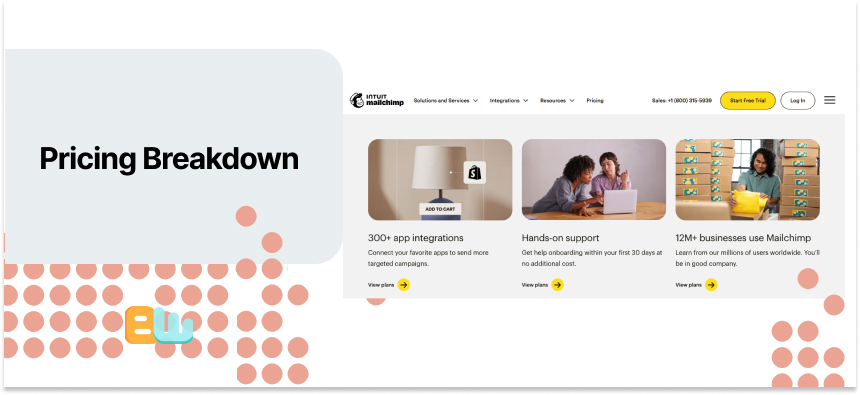
Cost matters—especially when you’re running a small business or working solo. Let’s break down how Flodesk and Mailchimp compare on pricing.
Flodesk keeps things simple. You pay one flat rate no matter how many people are on your list. It’s $38/month or $35/month if you pay yearly. You get unlimited subscribers, unlimited email sends, and access to all features. There are no hidden upgrades. And they offer a free 30-day trial so you can try it before you commit (source).
Mailchimp, on the other hand, uses a tiered pricing model. They offer more plans with different limits and features:
- Free plan: Up to 500 contacts and 1,000 email sends per month
- Essentials: Starts at $13/month, includes more templates and email support
- Standard: Starts at $20/month, adds automation and analytics
- Premium: Starts at $350/month, designed for large teams with advanced needs
As your email list grows, Mailchimp gets more expensive. If you have 2,500 contacts, for example, even the Essentials plan can jump to $39/month or more.
| Feature | Flodesk | Mailchimp Free | Mailchimp Essentials | Mailchimp Standard | Mailchimp Premium |
| Monthly Price (Starting) | $38 ($35/yr) | $0 | $13+ | $20+ | $350+ |
| Subscribers | Unlimited | 500 | 500+ (scales with price) | Scales with price | Scales with price |
| Email Sends | Unlimited | 1,000/month | Scales with price | Scales with price | Scales with price |
| Features | All included | Basic | Templates, support | Automation, analytics | Advanced tools |
Flodesk wins on simplicity. Mailchimp wins on flexibility. The best option depends on your list size, budget, and how much functionality you need.
Features: What You Actually Get

Choosing an email platform isn’t just about the price. It’s about what tools you get for that price—and how easy they are to use. Let’s take a look at how Flodesk and Mailchimp compare when it comes to features that actually matter to digital marketers.
Email Design and Templates
Flodesk shines when it comes to design. Their drag and drop function makes it easy and clean to use, you can create marketing art without needing any technical knowledge. Their Saving feature also means you can have your brand colors, fonts, and styles ready to go so your designs are always coherently on brand. Their platform also allows custom font insertions and supports third-party templates which offers more flexibility for the days you are feeling particularly creative. Their user-friendly interface makes sure that every email is also mobile-responsive so your email can shine through on any screen, big or small.
Mailchimp gives you more customization. They use a block-based editor like wordpress that might not be as smooth as Flodesk but gives you more control on your layout. They also let you save layouts, run A/B subject line tests, and preview your emails across devices. Mailchimp is perfect if you need more control over how your emails function and are received.
Automation & Workflows
Flodesk keeps automations simple. It uses a visual workflow builder that’s easy to understand. You can set up welcome sequences, lead magnets, and follow-up emails with a few clicks. All automations are included in the base price—no need to upgrade.
Mailchimp is more powerful here. You’ll have behavior based functions like an email being sent when someone clicks a link or makes a purchase. Unfortunately these options are only available to the higher paying users on the Standard or Premium plans. These automations may make your life easier but they take time to set up since they are a little bit complex.
Analytics & Reporting
Flodesk gives you the basics. You can track open rates, click-through rates, and audience growth. But that’s about it. There’s no A/B testing and no visual click maps, which can make it harder to see what’s working.
Mailchimp goes deeper. It offers revenue tracking, email click maps, and even benchmarking tools so you can directly compare your results with what other marketers in your industry are seeing. If data is a big part of your decision-making, Mailchimp gives you more insights.
Non-email Features
Flodesk is adding tools beyond email, but they’re still basic. You get:
- Signup forms to grow your list
- A checkout feature to sell digital products
- A Link in Bio tool for Instagram to share links in a styled landing page
Mailchimp offers a much wider range of marketing tools:
- Schedule social media posts
- Create landing pages and digital ads
- Manage contacts with a built-in CRM
- Organize assets in a central content studio
If you want beautiful emails with easy tools, Flodesk is a solid pick. If you need data, flexibility, and scalability, Mailchimp offers more—but you may have to pay more to unlock it.
Ease of Use & Onboarding

Getting started with a new email platform should be smooth. But not all tools are built the same.
Flodesk has a clean, minimalist dashboard. The layout is simple and easy to follow. If you’re not super tech-savvy, that’s a big plus. You can create emails and automations without much training. But it’s not perfect. There aren’t many tooltips or pop-ups to guide you, you may have trouble finding features like spacing and padding controls. Still, most users get the hang of it quickly.
Mailchimp, by comparison, offers more options. But that also makes it feel more complex. The dashboard has a lot of menus, tabs, and icons. If you’re new to email marketing, it might take time to figure things out. The upside? Mailchimp offers guided tutorials, a robust help center, and onboarding tips throughout the setup process.
Overall, Flodesk is easier to learn, but Mailchimp is more thorough once you’ve climbed the learning curve. It comes down to how much help you want—and how much complexity you’re willing to handle.
Integrations & Migration

Integration is important because your email platform needs to play nice with the other tools you use
Flodesk connects to top platforms like Zapier, Shopify, and Squarespace. You can place sign-up forms on your site or use Flodesk’s Link in Bio block for Instagram. If you are importing from Mailchimp, there is an import step-by-step tool to upload your contacts. It’s a breeze and just takes a few minutes.
Mailchimp has a much larger list of integrations. It does integrate with most e-commerce stores, social media sites, CRMs, and other marketing tools. If your business has more than one system and you want everything to be automated, Mailchimp provides you with greater flexibility.
Thinking of making the switch from Mailchimp to Flodesk? It’s not so hard. You take your list out of Mailchimp as a .CSV file, and transfer it into Flodesk. There’s even a guide to walk you through it.
But if your setup is simple and you are working with a few core platforms, then Flodesk would probably be enough.
Limitations and Trade-Offs

No email platform is perfect. Both Flodesk and Mailchimp have their downsides.
Flodesk keeps things simple, but that also means fewer advanced tools. It doesn’t offer A/B testing, so you can’t test subject lines or content versions. There are no click maps, either, so you won’t see exactly where people are clicking in your emails.
You can only manage one brand per account, and only one user can log in. That’s fine for solopreneurs, but not ideal for teams. Design customization is limited, too. Things like padding, spacing, and footer design aren’t very flexible.
Mailchimp, on the other hand, gives you more tools—but it comes at a cost. As your subscriber list grows, your price goes up. That’s something to think about if you plan to scale quickly.
And while it offers many features, not everyone needs all of them. For solopreneurs or small teams, Mailchimp might feel like overkill.
In short, Flodesk trades power for simplicity. Mailchimp trades simplicity for power. Which matters more depends on your business, your team, and how much control you want.
Customer Support and Learning Resources

Support matters—especially when you’re just starting out or something breaks.
Flodesk offers email support and a helpful online help center. There’s also a growing community where users share tips and ideas. While Flodesk doesn’t have live chat, many creators offer third-party courses and tutorials to help you learn the ropes.
Mailchimp provides more built-in help. If you’re on a paid plan, you get 24/7 live chat support. There’s also a massive library of help docs, videos, and step-by-step guides. The platform walks you through a lot of actions right from the dashboard.
If you prefer a self-paced learning experience with strong community support, Flodesk delivers. If you need faster help or more official guides, Mailchimp might suit you better. Both have solid resources—but they take different approaches.
Conclusion
Both Flodesk and Mailchimp are strong contenders in email marketing. You get clear designs, easy user interface and simple flat pricing which would make it a great choice for small businesses or one man teams trying to get a quick but stylish headstart. Mailchimp on the other hand offers all the marketing tools necessary to help you grow your business which is a perfect fit for the larger teams or the ones looking to take their emails to the next level.
All in all, for simplicity and beauty go with Flodesk and for power and scalability go with Mailchimp. Let your business’ marketing needs drive your decision.
FAQ
Do I need a website to use Flodesk?
No, you don’t need a website. Flodesk offers sign-up forms and a Link in Bio tool for Instagram to help you grow your list without a website.
What are the disadvantages of using Flodesk?
Flodesk lacks A/B testing, has limited design options, and allows only one user and one brand per account.
How much does Flodesk cost a month?
It depends on your payment method, if you choose a monthly subscription it’s gonna cost $38 per month but if you choose their yearly subscription it’s gonna cost $35 per month.
Is Mailchimp or Flodesk better?
It depends. Flodesk is simpler and design-focused; Mailchimp is more powerful and scalable.
Can I use Flodesk for free?
Flodesk offers a 30-day free trial. It’s mainly used for email marketing and list building.
